After close to 2 years, I am finally back to the intertidal zone!
The purpose for returning back to the blue was to continue with the sea cucumber research which I set aside 2 years ago. This project was highlighted during the recent Festival of Biodiversity organised by the National Parks Board.
The first stop was at Changi Beach Park, which has always been my favourite Singapore’s mainland intertidal spot because of the diversity of faunal life. I was with Ron and two of my colleagues.

The first creature we saw was the horned-eye ghost crab, Ocypode ceratophthalmus. This is a scavenger which is also known to be able to run very fast!

A live bivalve was attempting to burrow itself in the sane with much effort. It is interesting to observe its siphon which allows water to enter and exit its body for breathing and filter-feeding.

There were a lot prickly white sea urchin, Salmacis sp, scattered all over the beach. They camouflaged themselves by trapping pieces of shells, algae, and sea grasses cover their top.
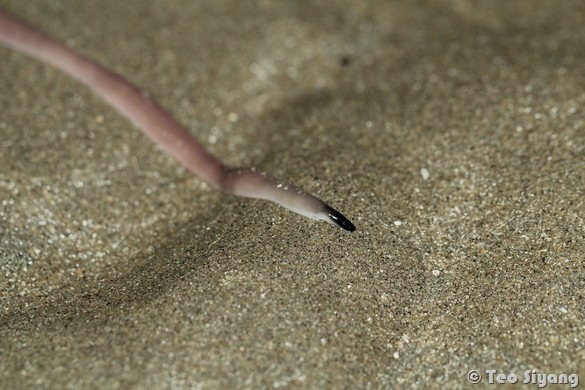
This ribbon worm was extremely long, being close more a metre! It seems as that this relatively common worm still do not have a scientific name yet. Hopefully the Mega Marine Survey will eventually help to solve this mystery.

A nice find was this knobbly sea star, Protoreaster nodosus. This is still a little juvenile, and can grow up to more than twice its size eventually.

There were quite a number of these sea slugs, or more specifically, the geographic sea hare, Syphonota geographica. They are thought to grazed on sea weeds.

I also found two octopi, one hiding in the a dead fan shell and another in a huge bailer snail shell.

Moving on to the sea cucumbers, I was quite surprised to find so many Holothuria notabilis. They lie buried horizontally just beneath the sandy surface with their butt sticking out for breathing. Yes, they breathe through their butt!
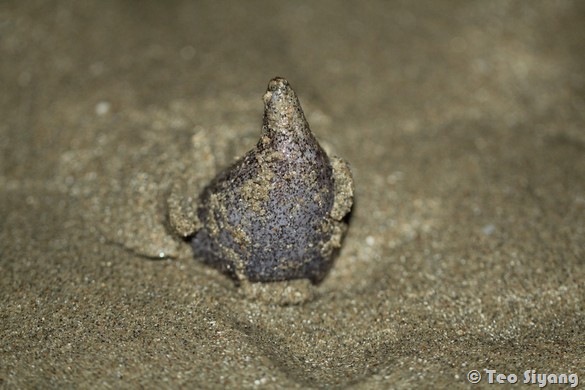
Another burrowing sea cucumber is this. In her comprehensive marine wild fact sheets, Ria named it as the smooth sea cucumber. Based on some of its external characters, including their simple stubby tentacles, they can be safely placed in the genus of Paracaudina sp. Microscopic examination will be needed to further zoom in on its identity.

Another which deserves some study is this purplish sea cucumber which is frequently found under the rocks. I was unable to tell what it was at first glance; hopefully it will not elude me for long.
Meanwhile, at the other end of Changi Beach, Ria has found another fascinating sea cucumber which she highlighted in her blog. This is really interesting because it is very likely to be from a new family of cucumbers that is never recorded in Singapore!


